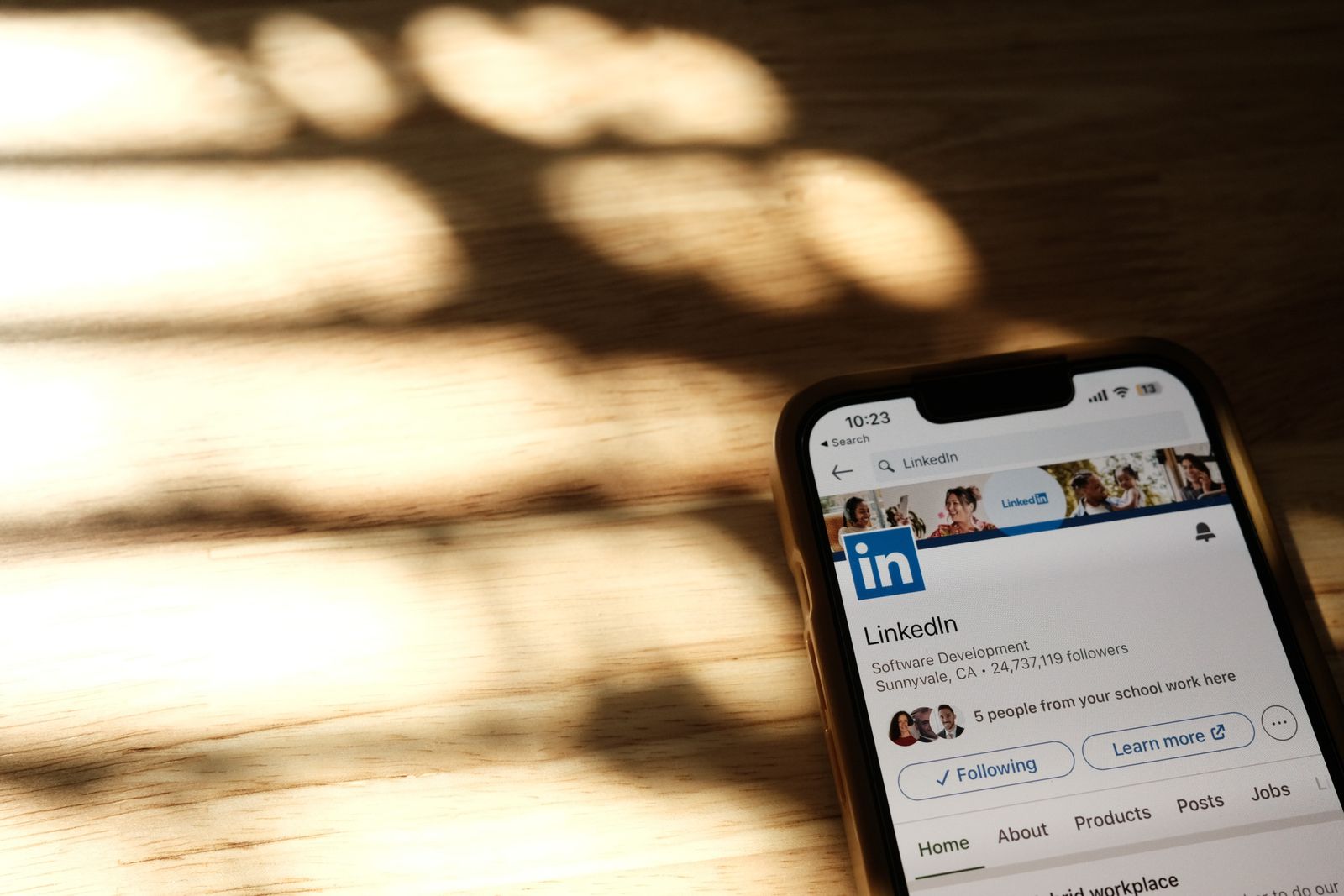
TL;DR: Yes — LinkedIn strips EXIF metadata, including GPS coordinates, from the version of your profile photo and post images that other members can see. It does this by re-encoding every uploaded image through its own processing pipeline, which discards the original EXIF, IPTC, and XMP blocks. But "strips it from the public copy" is not the same as "never had it." LinkedIn receives your full original file, metadata intact, at the moment you hit upload, and what it retains internally is governed by its privacy policy, not by what other users can download. If your goal is to keep the GPS tag on your headshot out of everyone's hands — LinkedIn included — the only reliable move is to remove the metadata yourself before the file is ever transmitted.
Does LinkedIn remove EXIF data from photos?
For the copy that other people can view or download, yes. When you upload a profile photo, a banner, or an image attached to a post, LinkedIn does not store and serve your original file. It runs the image through a server-side pipeline that re-compresses it, resizes it into several display variants, and writes out fresh JPEGs. EXIF, IPTC, and XMP metadata blocks do not survive that round trip. So when a recruiter, a competitor, or a stranger saves your profile picture, the GPS coordinates that may have been embedded by your phone are gone from the file they receive.
This is the same behaviour we documented for Facebook and for Instagram uploads. Large platforms re-encode images for performance and storage reasons, and metadata stripping is a side effect of that pipeline rather than a privacy feature they designed on purpose. The practical result is the same either way: the public-facing copy is clean.
The important nuance — and the part most "yes, LinkedIn strips EXIF" answers leave out — is the word public-facing. Stripping happens on the way out, not on the way in.
What LinkedIn receives before it strips anything
Your camera original travels from your device to LinkedIn's servers in full. That upload carries whatever your phone wrote into the file: the GPS latitude and longitude if location tagging was on, the timestamp, the device make and model, the lens, the exposure settings, and frequently an embedded thumbnail. LinkedIn ingests all of it, then produces the stripped display versions from it.
What LinkedIn does with the original metadata internally is a matter of policy rather than something you can observe from the outside. Its privacy policy describes collecting information you provide, including the content and metadata of what you post, and using it for purposes such as analytics, personalization, and advertising. None of that is visible to other members, but it is also not erased simply because the downloadable copy is clean. The Electronic Frontier Foundation has long made this same point about platform uploads generally: stripping protects you from other users, not from the platform itself.
So the honest answer to "does LinkedIn remove EXIF" is two-layered. From other members: yes, reliably. From LinkedIn: the metadata reached their servers, and you are trusting their retention and handling practices to manage it from there.
 Photo by Tochukwu Ekeh on Pexels.
Why this matters more for a profile photo than a vacation snapshot
A profile photo is not a throwaway image. It is one of the most viewed, most downloaded, and most scraped pieces of content you put online. Recruiters save it. Data brokers harvest it. Anyone running a reverse-image lookup starts from it. Because it is so widely distributed, a profile picture is exactly the kind of file where an embedded GPS coordinate would do the most damage if it leaked.
Where do those coordinates come from? Often from the most ordinary source imaginable: you photographed your own headshot, or had a colleague shoot it on a phone, in your home, your office, or a studio near where you live. If location services were enabled, that JPEG now carries the latitude and longitude of where it was taken, accurate to within a few metres. We covered how phones embed this in our breakdown of the hidden metadata your iPhone writes into every photo. For a casual photo you never share, that tag is harmless. For the image you broadcast to your entire professional network and the open web, it is a standing privacy liability — at least until the platform strips it on output.
The reason to care, then, is the gap between upload and display. LinkedIn closes that gap for everyone downstream. It does not close it for the transmission itself.
What stripping does not protect you from
Consistent with how we treat every platform on this blog, it is worth being precise about the limits of EXIF removal — both LinkedIn's and your own.
First, removing EXIF does nothing about the content of the image. If your headshot was taken in front of an identifiable building, a visible street sign, or a window with a recognizable skyline, no metadata operation touches that. Visual geolocation works on pixels, not tags.
Second, stripping EXIF does not undo what the platform already holds. As above, LinkedIn received the original. Cleaning the file after upload would not retroactively pull the metadata back from their servers. This is why the order of operations matters so much: the only way to keep a coordinate away from the platform is to remove it before the upload happens.
Third, EXIF is not the only metadata channel. Some images also carry IPTC and XMP blocks — copyright fields, captions, keywords, editing history written by software like Lightroom. A profile photo exported from a photo editor can carry your full legal name, your studio's name, or a copyright string even when the GPS tag is absent. Stripping has to clear all of those namespaces, not just the EXIF GPS field, which is one reason a thorough cleaner removes the IPTC and XMP blocks alongside EXIF.
 Photo by Bastian Riccardi on Pexels.
How to keep your metadata off LinkedIn entirely
If you only care about other members not seeing your GPS data, you can rely on LinkedIn's pipeline and do nothing. For most people that is a reasonable position. But if you would rather the coordinate never leave your device — so it never reaches LinkedIn's servers, never sits in their internal copy, and never depends on their retention policy — you strip it yourself first.
The workflow is short. Run the photo through Metadata Cleaner before you upload it. Because the cleaning happens locally in your browser, the file is scrubbed on your own machine and only the already-clean version is ever transmitted. The step-by-step above walks through it, but the principle is the entire point: clean before upload, not after. Our general walkthrough on how to strip EXIF data from a photo covers the same process for Mac, Windows, and iPhone if you want platform-specific detail.
A second habit helps even more: turn off location tagging in your camera app for the kind of photos you intend to publish. If the GPS coordinate is never written in the first place, there is nothing to strip. Most phones let you disable location access for the camera specifically, which keeps the tag out of headshots and product photos while leaving it on for the personal images where you actually want it.
Does LinkedIn treat profile photos, banners, and post images the same?
In terms of metadata, broadly yes. The profile photo, the background banner, and any image you attach to a post or article all pass through the same upload-and-re-encode pipeline, and all three come out the other side as freshly generated JPEGs without the original EXIF, IPTC, or XMP blocks. There is no special "private" upload path that preserves metadata for one image type and discards it for another — re-encoding is uniform because it serves LinkedIn's storage and delivery needs across the board.
What does differ is exposure. A profile photo is visible to anyone who can see your profile, which on a public setting means the entire internet, and LinkedIn deliberately makes it easy to view at a reasonably large size. A banner is similarly public. Post images can reach far beyond your network when a post is shared. So while the stripping behaviour is identical, the consequences of a metadata leak — in the counterfactual world where stripping failed — would scale with how widely each image travels. That is another argument for cleaning the file yourself: you remove the dependency on the pipeline working correctly for the most widely distributed image you own.
One more detail worth knowing: re-encoding also discards the embedded thumbnail that cameras tuck inside a JPEG. That matters because, on some older platforms and editing tools, an image could be visually cropped while its embedded thumbnail still showed the original uncropped frame. LinkedIn's regeneration eliminates that mismatch for the display copy. It is a small thing, but it is a genuine benefit of a pipeline that rebuilds the file from scratch rather than passing your original bytes through untouched.
The bottom line
LinkedIn does strip EXIF — including GPS — from the profile photos and post images that other members can see, because its image pipeline re-encodes every upload and discards the original metadata in the process. That protects you from recruiters, scrapers, and strangers downloading your picture. It does not protect you from LinkedIn itself, which receives your full original file the moment you upload and handles the metadata according to its own policy rather than according to what is downloadable. If you want a coordinate kept away from everyone, strip it before it ever leaves your device. The platform cleans the copy it shows the world; only you can clean the copy it keeps.
Try Metadata Cleaner free — remove EXIF, GPS, IPTC, and XMP from any photo in your browser, before it ever reaches an upload.